WASHINGTON, July 7 (San Diego News Online) — NOAA’s Climate Prediction Center says El Niño conditions are now present in the tropical Pacific and are expected to strengthen into the Northern Hemisphere winter of 2026-27.
For people in Washington and across the U.S., the practical takeaway is simple: start following NOAA’s winter outlooks and local weather updates now, especially if your plans involve travel, farming, coastal flooding, or other weather-sensitive work.
What NOAA says
In its June 11 ENSO Diagnostic Discussion, the Climate Prediction Center said an El Niño Advisory is in effect. The center said above-average sea surface temperatures have developed across the central to eastern equatorial Pacific Ocean, which is the region forecasters watch for El Niño.
NOAA said its latest weekly readings showed the Niño-3.4 index at plus 0.7 degrees Celsius, the Niño-4 index at plus 0.7 degrees, and the Niño-1+2 index at plus 2.1 degrees. Those are temperature measures used to track how much the tropical Pacific has warmed.
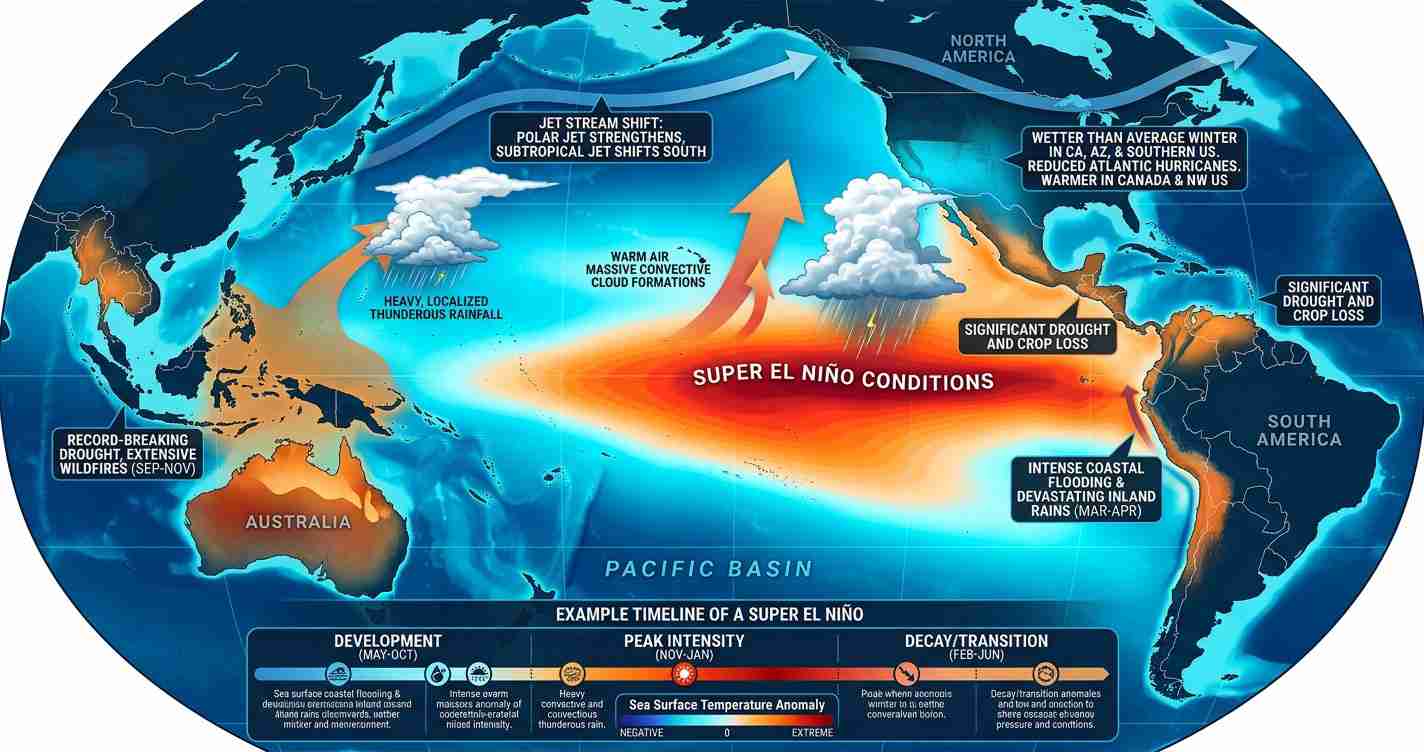
The center said model guidance, including the North American Multi-Model Ensemble and the NCEP CFSv2 model, points to El Niño strengthening through winter 2026-27. NOAA said there is a 63% chance of a very strong El Niño during November through January.
What is El Niño?
El Niño is one phase of a larger climate pattern called ENSO, short for El Niño-Southern Oscillation. It happens when parts of the central and eastern equatorial Pacific become warmer than average.
That warming can shift weather patterns around the world. In the U.S., El Niño often changes the odds of warmer, cooler, wetter, or drier conditions in different regions, but it does not guarantee a certain outcome in any one city.
In other words, El Niño is a signal that seasonal weather patterns may tilt in a certain direction. It is not a storm warning.
Why forecasters care now
The Climate Prediction Center said the warm water developed over the past month, building on earlier changes it saw in February and April.
NOAA’s forecast is important because El Niño often matters most in winter, when its influence on the jet stream can be stronger. NOAA has said the pattern can also affect high tide flooding in some U.S. locations.
That is one reason people in coastal areas, and anyone planning winter travel or work that depends on weather, may want to pay closer attention to official forecasts over the next several months.
How this affects Washington readers
Washington, D.C., is not the place where El Niño itself is measured, but it is a useful place to follow the federal forecast. NOAA’s Climate Prediction Center is based in the Washington area, and its outlook is a national one.
For local readers, the best next step is to watch NOAA updates, along with local National Weather Service forecasts and any flood guidance if you live or travel near the coast. El Niño can influence winter conditions, but local weather still depends on many other factors.
What to watch next
Forecasters will keep tracking whether the tropical Pacific keeps warming and whether the event grows stronger heading into late fall and winter.
If NOAA’s outlook holds, the most important window to watch is November through January, when the agency says a very strong El Niño is possible.
For now, the main message from NOAA is straightforward: El Niño is here, and the odds favor a stronger event by winter.