NTSB Releases Chilling Frame‑by‑Frame Images of UPS MD‑11 Engine Separation in Louisville
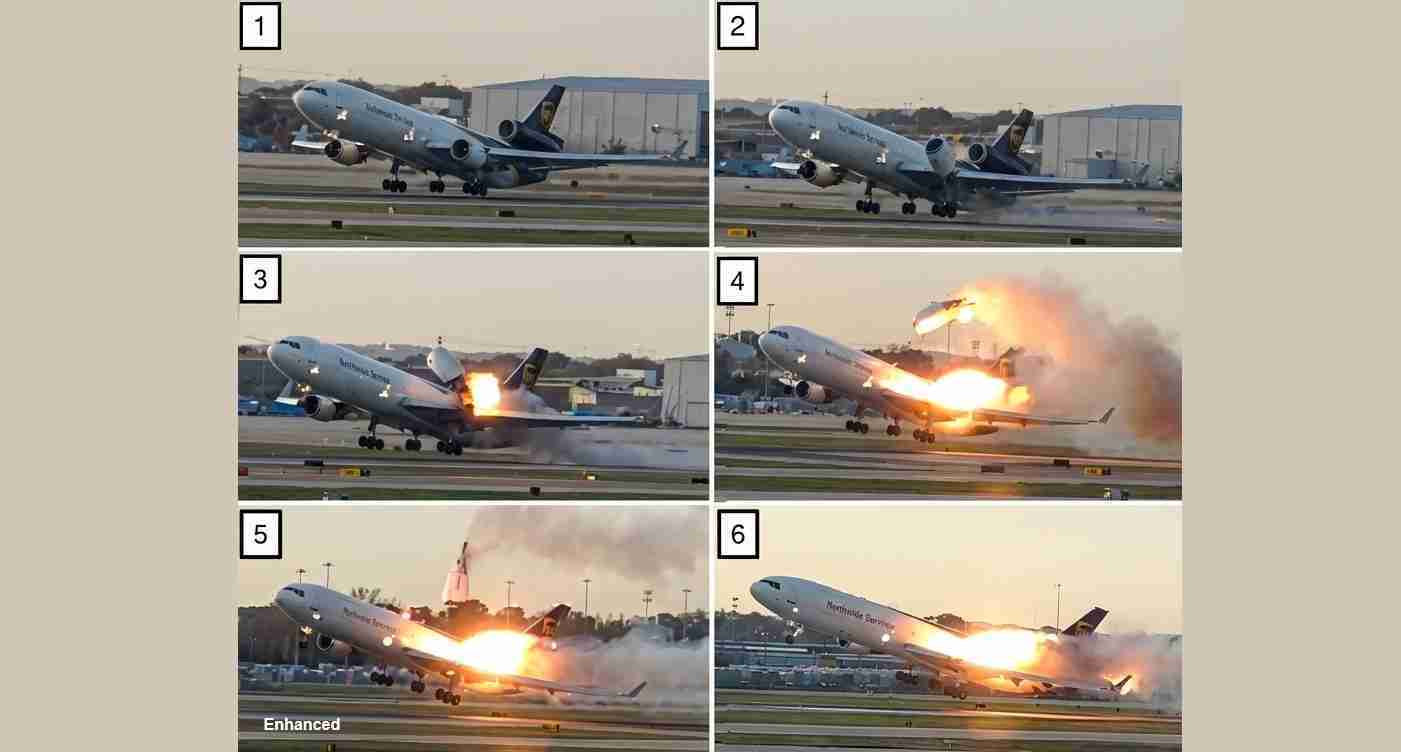
The NTSB released surveillance stills showing the left engine and pylon separating from a UPS MD‑11F during takeoff from Louisville on November 4, 2025, an accident now linked to probable fatigue cracking that killed 14.
- Engine separation captured: Six surveillance frames show the No. 1 engine and pylon breaking away almost immediately after rotation.
- Probable cause under review: Investigators are focused on fatigue cracking in the left engine pylon and attachment hardware as a primary factor.
- Casualties and damage: 14 confirmed dead (three crew, 11 on the ground) and 23 ground injuries; extensive structural damage reported.
- Next steps: Metallurgical testing, maintenance-log reviews and potential safety recommendations for MD‑11 and similar designs.
What the images show
The NTSB released a sequence of six still frames from airport surveillance cameras capturing the moments after the MD‑11 rotated for takeoff. The frames document the left (No. 1) engine and its pylon breaking away from the wing nearly immediately after rotation. In the sequence the engine vaults up and over the fuselage and a burst of fire blossoms at the wing‑pylon junction, tracking the falling engine until ground impact.
Media outlets published the stills and video alongside the board’s update; see reporting and primary sources for the footage and factual release below.
NTSB preliminary findings and fatigue focus
In its preliminary factual report the board confirmed the No. 1 engine and pylon separated just after rotation and that a fire began at the detachment point and continued until ground impact. Early investigative work has zeroed in on metal fatigue in the pylon structure near attachment points. Officials described fatigue cracking as a critical area under review and are performing detailed examination of the pylon and attachment hardware.
Investigators are collecting maintenance records, historical inspection data and material samples to run laboratory analyses that will determine crack‑growth history and whether inspection protocols at the time would have detected the damage. The board will consider whether inspection protocols for similar aircraft need strengthening and whether safety recommendations are warranted.
Crash sequence, damage and casualties
After the engine separated and the fire began, the MD‑11 climbed briefly to roughly 30 feet, then lost control and struck buildings beyond the runway. The impact and ensuing fires caused the majority of ground fatalities and injuries. Emergency and firefighting operations followed while investigators secured the scene and began evidence collection.
NTSB note: The board released the images with a factual update to clarify the sequence of failure for the public and investigators; the investigation remains ongoing and final conclusions will appear in later reports.
Victims and local response
Federal and local officials confirmed 14 deaths — three crew members and 11 people on the ground — and 23 reported ground injuries. Emergency crews, investigators and community leaders mobilized to assist survivors and secure evidence. The NTSB is coordinating with local authorities and federal agencies during the investigation.
Media and public reaction to crash images
The NTSB’s release prompted broad coverage; outlets described the frames as dramatic and disturbing, and aviation specialists emphasized the footage’s value for understanding timing and mechanics. The board cautioned the public that the probe is ongoing and that final probable‑cause determinations will come later.
Investigation next steps
- Metallurgical testing to determine crack initiation and growth.
- Review of maintenance, inspection logs and service histories.
- Interviews with maintenance and operations personnel and coordination with manufacturers to assess stress points and histories.
- Potential recommendations on inspection routines, maintenance intervals or design modifications if fatigue cracking is confirmed.
Sources and further reading
- NTSB preliminary report and NTSB investigation page
- Flying Magazine coverage
- AVweb report
- ABC News coverage
- NBC Palm Springs coverage
- FreightWaves analysis
- Public video of released frames: YouTube clip 1; YouTube clip 2
Implications for The Imperial Valley, California
Economic impact: The Imperial Valley’s agriculture and time‑sensitive freight depend on reliable air cargo. Potential outcomes of the investigation — stricter inspections, maintenance mandates or temporary fleet groundings — could raise costs and slow shipments. Local shippers and growers should monitor carrier notices and contingency plans.
Political consequences
Local officials may face pressure to advocate for stronger federal oversight of maintenance practices and clearer communication about cargo safety. Constituents inclined toward practical solutions may call for improved inspection reporting and industry transparency rather than sweeping regulation.
Social effects
The widely shared crash images may increase anxiety among residents near small airports or common cargo routes. Emergency managers and school districts should review response plans and alert systems; health services and nonprofits that aided victims in Louisville could offer lessons on trauma care and community support.
Cultural relevance
In the Imperial Valley’s close‑knit agricultural communities, reliable shipping is integral to daily life. News of a cargo jet disaster can resonate deeply; messaging that emphasizes actionable safety steps and timelines for industry changes will help maintain public confidence.
Practical applications for local businesses and government
- Contact carriers and freight forwarders to confirm contingency plans and alternative routing if MD‑11 operations change.
- Reassess emergency hazard maps and response times for airports and industrial zones.
- Coordinate drills between local airports, fixed‑base operators and first responders.
- Employers depending on overnight air freight should evaluate inventory buffers and insurance to reduce disruption risk.
Residents and businesses in the Imperial Valley can follow updates from the NTSB and major carriers as the investigation continues. Key sources include the NTSB preliminary report, Flying Magazine, and news coverage containing the released images such as ABC News and NBC Palm Springs.