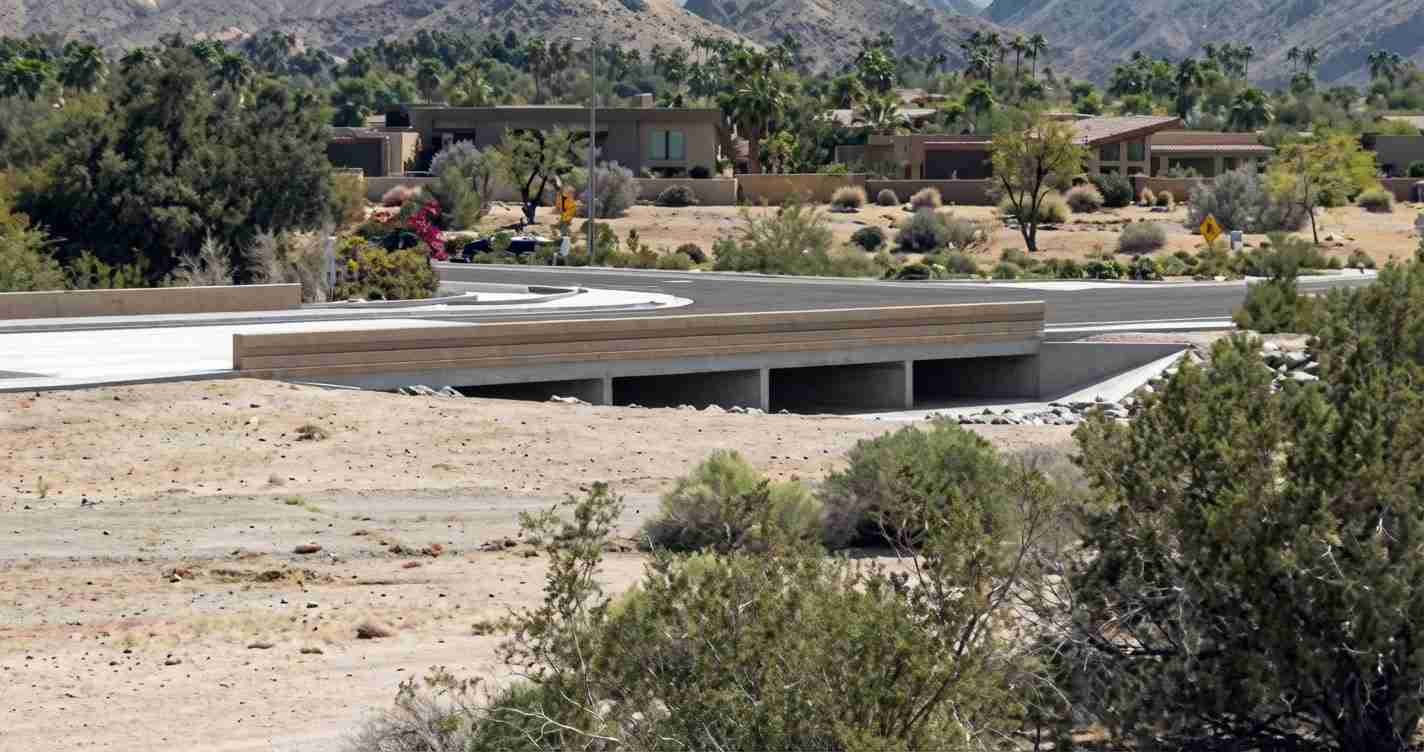
Palm Springs bridge lawsuit threatens low-water crossing on South Palm Canyon Drive, puts $4.5 million in federal funds at risk
Palm Springs’ planned low-water bridge on South Palm Canyon Drive faces a legal challenge by the Center for Biological Diversity that could delay construction at least two years and imperil about $4.5 million in federal Highway Bridge Program funding.
- Litigation: The Center for Biological Diversity filed suit on Aug. 20, 2025, seeking further CEQA analysis and to set aside the July 21, 2025 approval.
- Funding at risk: Roughly $4.5 million in federal Highway Bridge Program money could be jeopardized if construction is delayed past December 2026 without a waiver.
- Public safety vs. habitat: City and Fire Department call the bridge a lifesaving priority for ~700 homes; opponents cite potential harm to Peninsular bighorn sheep and other resources.
- Next steps: City continues CEQA work while litigation proceeds; a multi-year delay could force reevaluation of funding and design.
Key information — what’s happening now
The Center for Biological Diversity filed a complaint on Aug. 20, 2025 asking a court to set aside Palm Springs’ July 21, 2025 approval of the South Palm Canyon Drive low-water bridge and to require additional environmental study under the California Environmental Quality Act (CEQA). Sources: City project page; The Palm Springs Post reporting.
In a City update on March 6, officials warned the litigation could push construction back by at least two years while the city conducts further CEQA analysis — a delay that could jeopardize roughly $4.5 million in federal Highway Bridge Program funding that must be used by December 2026 unless a waiver is granted.
Purpose: The bridge is designed to ensure emergency access to about 700 homes in south Palm Springs that currently rely solely on South Palm Canyon Drive. City and Palm Springs Fire Department officials say the crossing is a public-safety priority. Source.
Project background and why the bridge was proposed
The proposed low-water bridge would be built near East Bogert Trail (also referenced as Arenas Canyon) over an alluvial fan and would include an elevated span and a reinforced concrete channel to carry storm flows beneath the bridge. Engineers estimate the alluvial fan can carry up to 1.3 million gallons per minute in a 100-year storm. The design would affect roughly 3.5 acres of the Oswit Canyon Nature Preserve. Project facts; The Palm Springs Post.
Supporters point to repeated road closures during heavy rain — including a major Valentine’s Day flood in 2019 that briefly blocked vehicle access — and city records showing hundreds of emergency calls from the area. Officials emphasize older residents and others could be at greater risk if the road is cut off during disasters. Source.
Development timeline and funding snapshot
The project dates to 2006, when preliminary studies began and the city first secured federal Highway Bridge Program funds. An initial CEQA review was completed in 2012. Over time the estimated total project cost rose to about $9–$10 million. Funding sources include the original $4.5 million federal allocation, local gas tax, Measure A, and other local funds. The city is pursuing additional funding from Caltrans and seeking a deadline extension to use the federal money beyond December 2026. City project page; The Palm Springs Post.
In 2020 the city reached a settlement with the Oswit Land Trust (OLT) to give the trust a role in commenting on bridge design, allowing the project to move forward without additional litigation from OLT at that time. Opponents argue landscape changes and habitat restoration since 2012 make the earlier CEQA review out of date. Settlement and design comments; The Palm Springs Post.
The legal challenge — what the lawsuit says
The Center for Biological Diversity’s complaint contends the city’s July 21 decision rejected an Oswit Land Trust design alternative and moved ahead with the city’s preferred elevated bridge and concrete drainage. CBD alleges the city’s CEQA analysis did not fully examine impacts to Peninsular bighorn sheep, Casey’s June beetle, and other sensitive resources. The suit seeks new studies, evaluation of additional alternatives, and more stringent mitigation before construction can begin. Lawsuit and claims; Reporting.
City officials say they are continuing CEQA work, including an addendum process, even as litigation moves forward. The March 6 community update cautioned the dispute could delay the project by at least two years — a timeline likely to conflict with the federal funding deadline and endanger the grant. City update.
Environmental concerns — endangered species and habitat
Oswit Canyon is recognized habitat for the Peninsular bighorn sheep, an endangered species with strong legal protections. Opponents argue restoration work and removal of old concrete channels by OLT since 2012 have improved habitat and that a larger, harder-footprint design could harm wildlife. The lawsuit highlights potential harm to bighorn sheep, Casey’s June beetle, and other sensitive resources that, if not fully studied, could violate CEQA. Environmental details; The Palm Springs Post.
The Oswit Land Trust previously removed concrete roadbeds and carried out restoration intended to reduce runoff and improve ecological value — a history central to critics’ argument that the 2012 CEQA work is no longer sufficient. OLT restoration actions.
Public safety and community response
City leadership and the Palm Springs Fire Department emphasize the bridge is a lifesaving public safety project. The city stated in its March 6 community update:
“This is a lifesaving public safety project and is a top priority for the community and the City.”
Fire Chief Paul Alvarado wrote,
“I support that bridge. I need to make sure that my rescuers can get to calls where they need to go.”
The fire department logged hundreds of calls to the southern neighborhoods in 2024 alone. City update; Reporting.
Many residents cite the 2019 Valentine’s Day flood as a clear example of why a reliable crossing matters. Opponents counter that significant floods are rare and that less intrusive alternatives or design changes could deliver safety with a smaller footprint in the preserve. Community debate.
Past delays and broader context
The bridge has been under discussion since 2006 and has experienced delays from complex environmental review, community debate, prior litigation, and changing engineering estimates. Council members point to recent storms across the region as reminders that weather and runoff risks are real. A prior neighborhood example in Palm Springs — the Araby area — shows how funding and disputes can leave bridges unbuilt and neighborhoods vulnerable to later flooding. Project history; Reporting.
Implications for The Imperial Valley, California
Economic: Loss of federal funds or project cancellation could mean local and regional contractors miss work, and state/local matching funds remain tied up in planning — raising questions about near-term reallocation. Funding details.
Political: Elected leaders may face pressure from safety advocates and conservation groups; the case underscores how litigation and environmental review affect timelines for critical infrastructure and may shape future designs and approvals. Political context.
Social and cultural: Delays may leave residents feeling more vulnerable, particularly older adults reliant on the route. The Oswit Canyon preserve is part of local cultural identity; concern for the Peninsular bighorn sheep resonates regionally. Planners in Imperial Valley may apply lessons on evacuation redundancy and funding contingency planning. Community safety and cultural considerations.
Reporting notes and sources
- City of Palm Springs project page and community update
- City project page (alternate link)
- The Palm Springs Post reporting on the lawsuit and delay
- The Palm Springs Post coverage of council decisions and project history
Legal filings and detailed environmental analyses referenced in the city update and press coverage remain under review. As of the latest public documents, the city continues CEQA work while the lawsuit proceeds and no final court ruling had been reported publicly. Ongoing status; Reporting.