Two pilots killed, dozens hurt after Air Canada Express jet strikes Port Authority fire truck at LaGuardia in deadly runway collision
On March 22, 2026, Air Canada Express Flight 8646 struck a Port Authority fire truck on Runway 4 at LaGuardia, killing both pilots and injuring dozens; the crash closed the airport and triggered an NTSB investigation.
- Fatal collision: Both pilots aboard the Bombardier CRJ‑900 were killed; dozens of passengers, crew and firefighters were injured.
- Operational shutdown: LaGuardia was closed under an FAA ground stop and remained shut into the following day, forcing widespread cancellations and diversions.
- Active NTSB probe: Investigators recovered the cockpit voice recorder intact and began work on the flight data recorder, reviewing ATC, ASDE and surveillance footage.
Key information
Flight: Air Canada Express Flight 8646, a Bombardier CRJ‑900 operated by Jazz Aviation (registration C‑GNJZ). Sources: Fox News, Airlineratings, Business Insider.
People on board: 72 passengers and 4 crew (captain, first officer and two flight attendants). Sources: Fox News, ABC News, Business Insider.
Casualties: Both pilots were killed. More than 39 passengers and crew plus two Aircraft Rescue and Firefighting (ARFF) officers were hospitalized; at least 32 people have been released. Sources: Fox News, ABC News, The Jerusalem Post, Business Insider.
Airport impact: The FAA ordered a ground stop and LaGuardia was closed through much of the following day, reopening around 2 p.m. Monday; FAA and Port Authority remain involved. Sources: Fox News, ABC News, The Jerusalem Post.
Investigation: The NTSB recovered the cockpit voice recorder (CVR) intact and transported it to Washington, D.C.; flight data recorder (FDR) work began afterward. Sources: Fox News, ABC News, The Jerusalem Post.
What happened: sequence and initial evidence
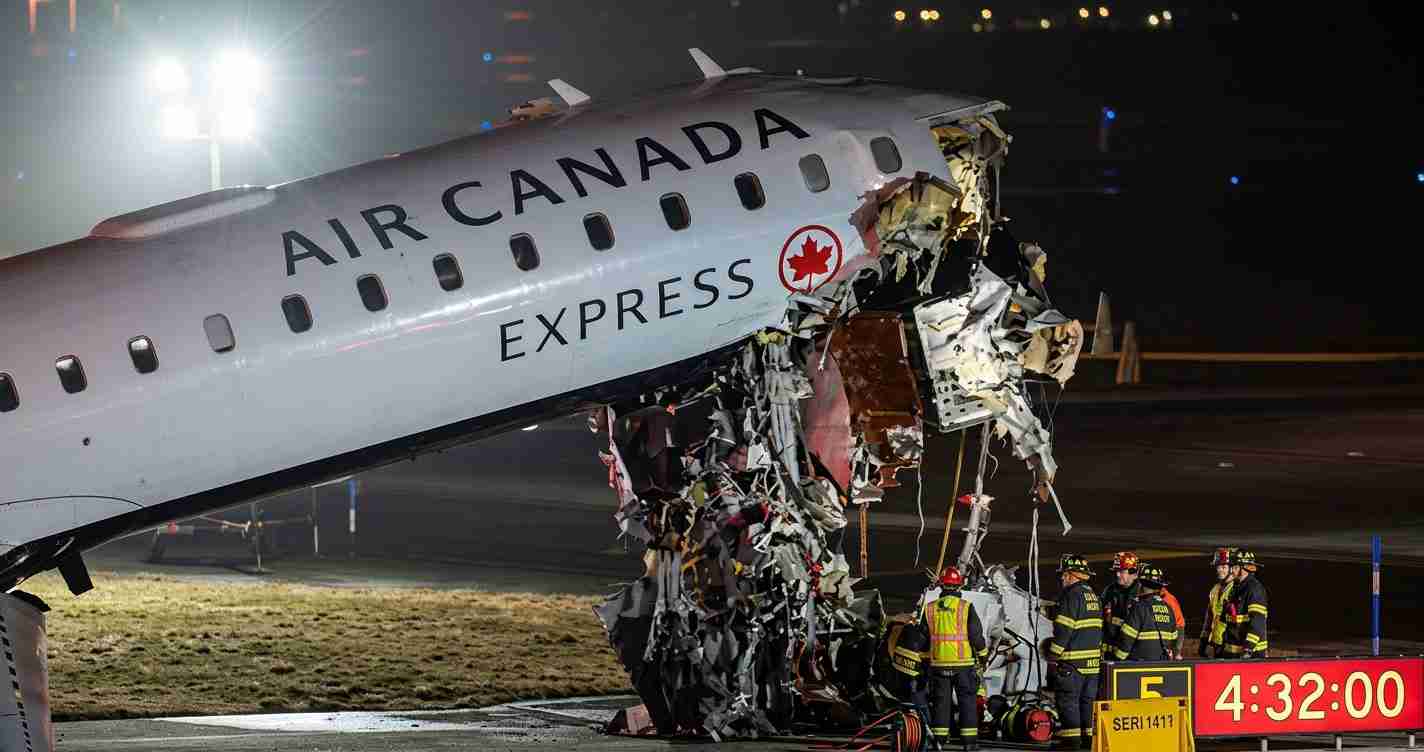
Investigators say the CRJ‑900 touched down on Runway 4 around 11:45–11:47 p.m. ET on March 22 after a flight from Montreal. The aircraft was rolling out when it collided head‑on with a Port Authority ARFF truck that was on the runway, according to multiple reports and airport officials. Sources: Fox News, ABC News, Airlineratings.
Audio from air traffic control captured controllers urgently ordering the truck to stop —
“Truck 1, stop, stop, stop”
— with no apparent response before impact. Reports say the truck had been responding to a separate aborted takeoff and had been cleared to cross Runway 4 at taxiway Delta. Investigators are examining why the truck entered or stayed on the runway while the arriving jet was landing. Sources: Fox News, ABC News, Airlineratings.
Damage, speed and debris
Photographs and video show severe nose damage to the CRJ‑900 and the plane sitting tilted, with a ripped forward fuselage and landing gear that appears to have struck the truck. Accounts differ on the aircraft’s exact speed at impact: Flightradar24 reported data suggesting around 24 mph (39 kph) on rollout, while other accounts cited higher speeds. The aircraft skidded roughly 130 meters toward a taxiway intersection, leaving debris across the runway and taxiway. Sources: Fox News, Airlineratings, The Jerusalem Post.
Casualties and emergency response
Port Authority Executive Director Kathryn Garcia briefed reporters and confirmed that both pilots were killed and that more than 39 passengers and crew and two ARFF officers were hospitalized. At least 32 hospitalized people were later released; some injured people suffered serious wounds. Two Port Authority firefighters were reported to have broken bones and serious but non‑life‑threatening injuries. Transportation Secretary Sean Duffy’s office confirmed the flight carried four crew members. Air Canada said family notifications were underway and that a care team was activated. Sources: Fox News, ABC News, Business Insider, The Jerusalem Post.
Investigation: recorders, surveillance and ATC data
NTSB Chair Jennifer Homendy said investigators retrieved the cockpit voice recorder and that it “was not damaged.” Crews cut a hole in the aircraft roof to reach the recorders; the CVR was transported to the NTSB’s labs in Washington, D.C. Work to download and analyze flight data recorder information began the next day. The NTSB is reviewing surveillance video, air traffic control communications and a replay of the airport surface detection system used by controllers. Homendy said investigators hope the FDR will show the relative positions and movements of the plane and the fire truck in the moments before the crash. Sources: Fox News, ABC News, The Jerusalem Post.
Operational impact and airport reopening
The FAA issued a ground stop at LaGuardia and a NOTAM noting the airport would be closed until about 2 p.m. Monday, a shutdown that forced cancellations and diversions at one of the nation’s busiest terminals. Officials said clearing the debris field and documenting wreckage would take days because investigators must carefully collect evidence across multiple areas of the runway and taxiway. The crash marked LaGuardia’s first fatal accident in roughly three decades and added to operational strain at airports nationwide. Sources: Fox News, ABC News, The Jerusalem Post.
Questions investigators are focusing on
NTSB and FAA investigators said they are working to determine how a fire truck and a landing aircraft came to be on the same runway despite ATC clearances and stop commands. The probe will analyze controller actions, vehicle and aircraft movement data, dispatcher logs, training records and potential equipment or communication failures. Surveillance footage and ASDE (airport surface detection equipment) replays are expected to be central to reconstructing the final seconds before impact. Sources: Fox News, ABC News, Airlineratings.
Implications for The Imperial Valley, California
Economic impact: The LaGuardia runway accident and prolonged closure ripple through national air travel and can affect fares and connections for travelers in the Imperial Valley. Residents who fly to New York often connect through major hubs; delays, cancellations and reduced seat availability can raise costs and complicate business or medical travel plans. Local travel businesses, shuttle services and travel agencies in Imperial County may see short‑term booking disruptions. (Sources: Fox News, ABC News.)
Political consequences: Local officials and transportation planners in Imperial Valley may press for attention to national airport safety standards and emergency response coordination. The crash is likely to renew discussion among policymakers about funding for airport safety programs and investments in surface‑detection and communication systems that aim to prevent runway incursions. California and county leaders could cite the incident when advocating for federal grants or legislative action. (Sources: Fox News, Airlineratings.)
Social effects: Families in the Imperial Valley with ties to the Northeast — whether for work, education, or health care — may face stress from disrupted travel and concern about flight safety. Local hospitals and emergency services will watch the investigation’s findings, particularly because the collision involved airport rescue personnel; lessons on ARFF procedures and cross‑agency coordination could be adopted at regional airports that serve the Imperial Valley. (Sources: Fox News, The Jerusalem Post.)
Practical applications for residents: Travelers from the Imperial Valley should check flight itineraries carefully, allow extra time for connections, and sign up for airline alerts in the days after major airport incidents. Businesses that rely on timely cargo or passenger travel should review contingency plans for rerouting and customer communication. Local airport managers may use this investigation to review ARFF training, crossing procedures and vehicle tracking to reduce the risk of runway incursions. (Sources: Fox News, Airlineratings.)
Sources
- Fox News
- ABC News
- Business Insider
- Airlineratings
- The Jerusalem Post (article‑890855)
- The Jerusalem Post (article‑891003)
Reporting note: This article preserves facts, times and source links from the accounts cited above. Quotes, timelines and investigative details reflect initial public briefings and media reports; the NTSB and FAA continue active analysis.