Chevron Warns California Gas Prices Could Soar as Company Threatens Exit, Raising Alarms Over California Refinery Closures
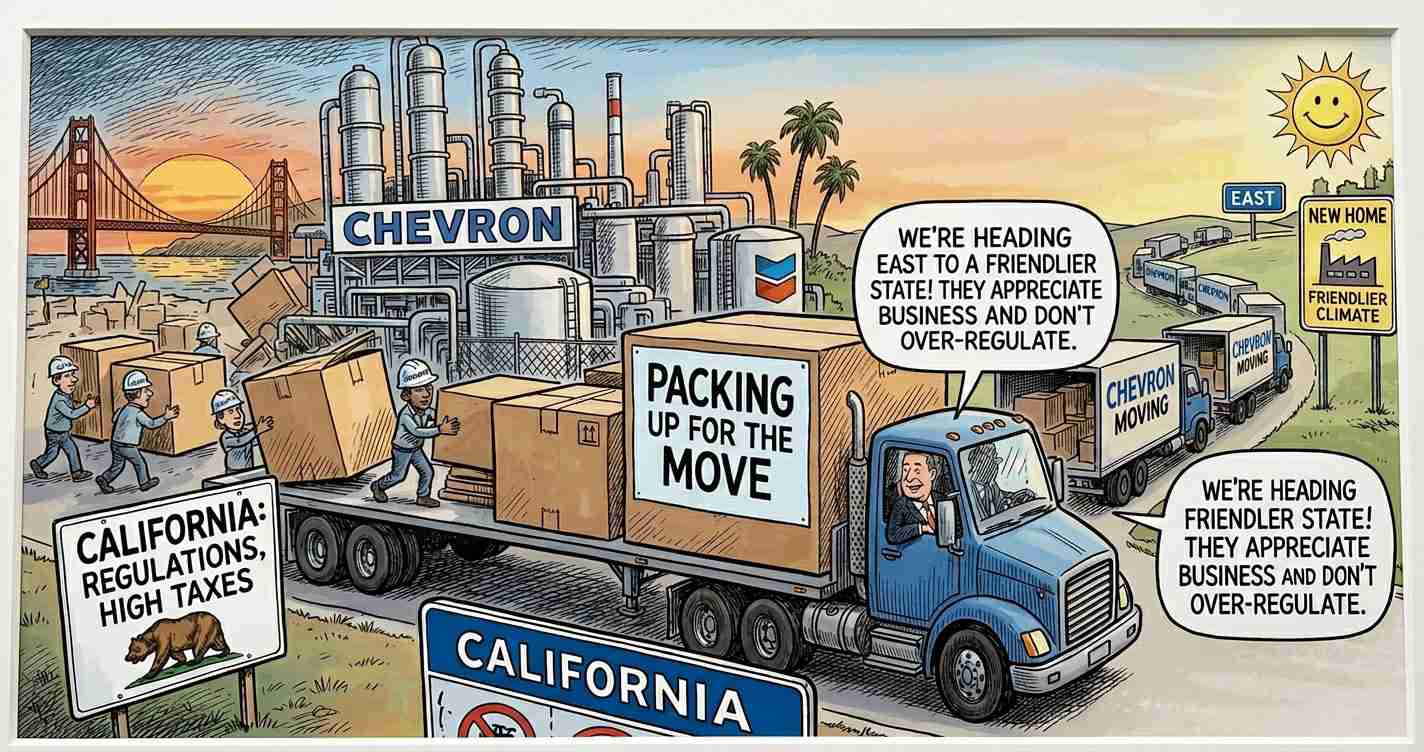
Chevron President Andy Walz warns Californians could face severe fuel shortages and gas prices soaring over $1 per gallon by 2030, citing stricter Cap-and-Invest rules, global supply shocks tied to the Iran war, and possible refinery exits.
- Policy and cost risk: Chevron says changes to California rules — notably the Cap-and-Invest program — could make refining uneconomic and add up to $500 million in costs over five years (Insurance Journal).
- Capacity impact: The company warns it could exit California refining within a decade, potentially removing roughly 34% of state refining capacity (California Energy Commission data) (Insurance Journal).
- Supply shocks: Walz cites disruptions tied to the Iran war and the Strait of Hormuz that have reduced Asian refining output — tightening supplies that California imports (Insurance Journal; Fox Business).
What Chevron is saying
In a letter to Gov. Gavin Newsom and state regulators, Chevron President Andy Walz argues tighter emissions caps and higher compliance costs threaten to render refinery operations uneconomic in California. Walz wrote that “adversarial policies at local, regional and state levels have eroded that foundation,” calling the proposed changes a “shakedown.” He warned the company could face added costs of up to $500 million over five years under new rules (Insurance Journal).
Walz also highlighted global disruptions: shipments tied to the Iran war and blockages near the Strait of Hormuz have reduced processing at Asian refineries. That tightening of Asian output matters because California both imports refined fuel from Asia and takes crude from overseas suppliers now under strain. Chevron said it has rerouted Gulf Coast oil through the Panama Canal as a short-term response (Insurance Journal).
How California’s supply system works — and why it matters
California is often described as an “energy island.” The state lacks pipeline links to major refining hubs in Texas and Louisiana, and more than 90% of the gasoline used in the state is refined locally, according to the California Energy Commission. That makes the state highly sensitive to in-state refinery outages: large closures can cause immediate local shortages and sharp price spikes (Insurance Journal).
Chevron operates two of the state’s largest refineries; a shutdown of those facilities would cut state refining capacity by roughly 34%, a loss industry groups say would push prices up and threaten supply reliability (Insurance Journal).
The Cap-and-Invest debate
At the center of Chevron’s complaint is the Cap-and-Invest Program California, a state policy that limits greenhouse gas emissions and requires companies to hold permits for carbon. Proposed amendments would reduce allowances and speed deep emissions cuts toward mid-century. Chevron argues the changes would raise compliance costs, accelerate refinery closures, and shift emissions and jobs offshore without lowering global carbon output (Insurance Journal; Fox Business).
Industry figures cited by Chevron estimate the proposed changes would reduce allowances by roughly 118.3 million from 2027 to 2030, and the state’s long-term goals aim for roughly 85–90% emissions reductions by 2045. Chevron and allied groups warn of potential job losses numbering in the hundreds of thousands and higher fuel prices across transportation and aviation fuels (Insurance Journal).
State and political responses
Gov. Newsom’s office pushed back against Chevron’s warnings. State officials accused oil companies of attempting to exploit the Iran war to seek rollbacks of climate rules, saying the industry is “cashing in” on global events and running a coordinated campaign to weaken progress. The governor’s office and regulators argue the state must meet climate goals and that industry claims overstate costs while ignoring investments in cleaner fuels and technologies (Insurance Journal).
The wider context
California enforces some of the nation’s strictest fuel standards and ambitious climate goals while remaining the second-largest U.S. gasoline consumer and the largest jet fuel market. That combination makes the transition from gasoline complex: although adoption of electric vehicles and cleaner aviation fuels is ongoing, current gasoline demand remains high — increasing the stakes of any refinery loss (Insurance Journal).
A nonprofit, Californians for Energy Independence, noted up to 70% of the state’s crude supplies can come from foreign imports — a figure Chevron and others cite to argue California’s exposure to global supply shocks is high. At times about 20% of California’s refined fuels have come from Asian suppliers, increasing vulnerability when Asian refining is interrupted (Insurance Journal; Fox Business).
Implications for The Imperial Valley, California
Economic impact: The Imperial Valley depends on affordable transport and goods. Higher gasoline and diesel prices would raise costs for farms, trucking, and local businesses; agriculture is fuel-intensive and rising fuel expenses would squeeze farm margins and could raise consumer food costs.
Political consequences: Local leaders may pressure Sacramento for exemptions or aid. Regional lawmakers could demand measures to protect agriculture and transport, including state relief funds or federal support for energy resilience.
Social effects: Residents already facing high living costs could be directly affected by higher gas prices. Commuters, school transport, and healthcare access in remote parts of the valley could be disrupted by fuel price shocks or shortages.
Practical applications: Local governments and businesses may plan for short-term shortages by stockpiling critical fuel for emergency services, shifting to more fuel-efficient fleets, expanding storage, or accelerating alternative-fuel and efficiency projects.
Other industry and policy notes
- Chevron requested an “energy emergency” declaration, increased in-state production, and regulatory relief to keep refineries operating (Insurance Journal).
- Critics point to prior refinery closures amid rising regulatory costs and warn that closures in California could move emissions offshore, negating some global climate benefits (Insurance Journal).
- The California Air Resources Board (CARB) and state agencies defend Cap-and-Invest amendments as necessary to meet climate targets; CARB has faced scrutiny for auction rules and limited public access to some meeting details, a point raised by industry critics (Fox Business).
Reporting notes and sources
This report draws on Chevron statements and industry commentary reported in late March 2026. Key reporting and analysis are based on Insurance Journal, with additional context from Fox Business and industry trade reporting (BIC Magazine).
Reporting shows a complex mix of drivers: global supply shocks tied to the Iran war and the Strait of Hormuz, California’s reliance on local refineries, and state climate rules like Cap-and-Invest. Each factor shapes the debate over whether policy changes or company decisions will drive refinery closures and higher fuel prices (Insurance Journal; Fox Business).
“Adversarial policies at local, regional and state levels have eroded that foundation,” Chevron President Andy Walz wrote, calling proposed changes a “shakedown” and urging state leaders to declare an energy emergency (Insurance Journal).