California hits milestone in electric truck charging as Kempower Mega Satellite runs first North American Megawatt Charging System test
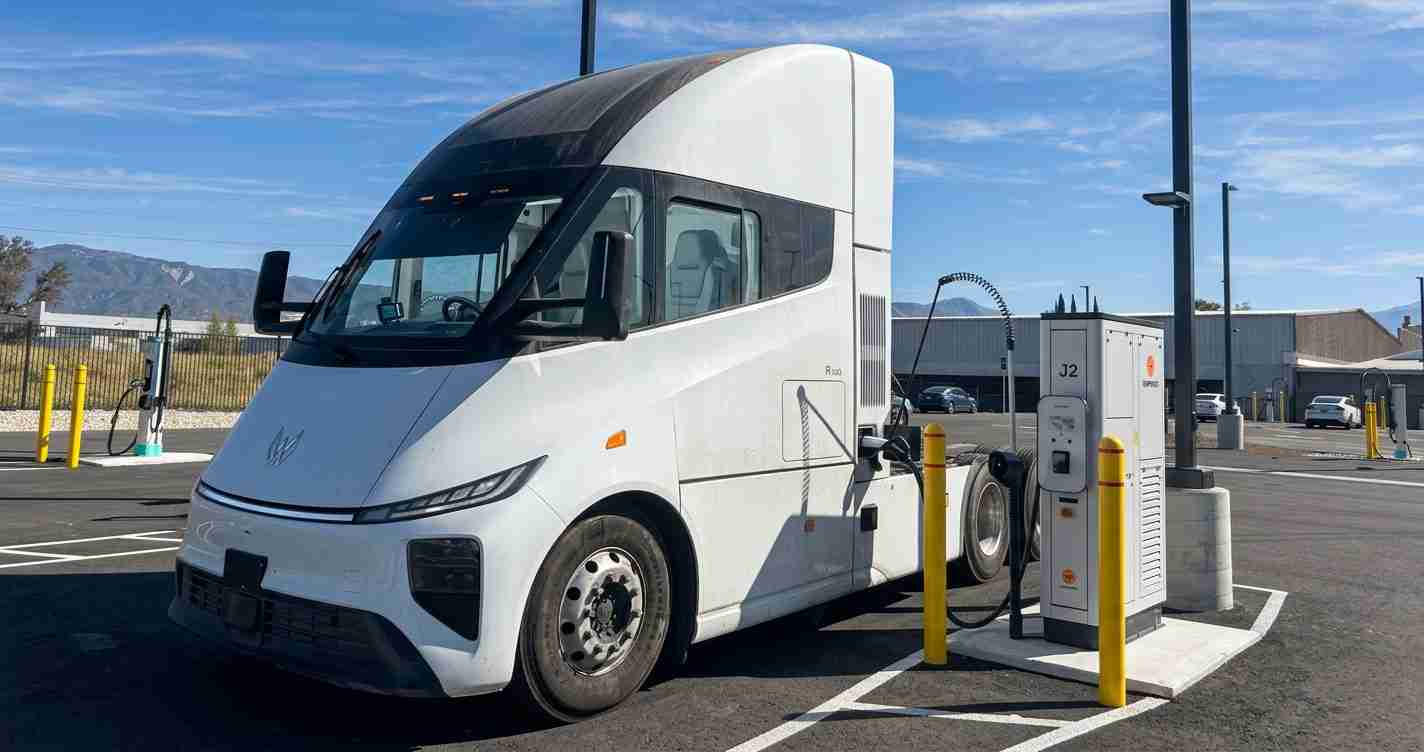
San Bernardino hosted North America’s first Megawatt Charging System session for heavy trucks, where Kempower’s Mega Satellite delivered over 1 MW of continuous power at EV Realty’s hub — a milestone for fast, fleet-ready heavy-duty charging.
Key takeaways
- First North American MCS session: Kempower, Windrose and EV Realty demonstrated >1 MW of continuous charging at EV Realty’s San Bernardino hub.
- High-capacity hardware: A 1,200 kW Kempower Power Unit with two Mega Satellite MCS dispensers can deliver up to 1.2 MW and 1,500 amps continuously using liquid-cooled cables.
- Practical readiness: EV Realty says sites are being built to serve any heavy-duty truck, preparing for MCS-capable trucks arriving in 2026.
- Regional implications: MCS hubs could reshape logistics, grid planning and jobs across Southern California corridors and the Imperial Valley.
Main content
Inside the San Bernardino site
EV Realty constructed the San Bernardino hub specifically for heavy-duty charging. The test used a 1,200 kW Kempower Power Unit connected to two Kempower Mega Satellite MCS dispensers, enabling up to 1.2 MW and 1,500 amps of continuous power. Operators relied on liquid-cooled cables to manage thermal loads and ensure stable charging during the session.
Source reporting and additional technical context are available from Electrek.
“Sites that can serve any heavy-duty truck, including those utilizing MCS. This test confirms that we will be ready for real-world MCS charging when the trucks hit the road later this year.” — Suncheth Bhat, EV Realty chief commercial officer (Electrek)
Why MCS matters for heavy trucks
The Megawatt Charging System (MCS) is a high-power standard designed for heavy-duty vehicles, built to deliver more than 1 megawatt and scalable up to 3.75 MW. That exceeds typical passenger EV fast chargers and enables much faster top-up charging for long-haul tractors and large freight haulers, translating to reduced downtime and lower operating cost per mile.
MCS relies on larger connectors, high-capacity power units and liquid-cooled cables to keep continuous megawatt-level charging safe and reliable; those design choices were present in the San Bernardino test (see Electrek and CALSTART).
A step toward real-world deployment
The San Bernardino trial was operational, not merely promotional. EV Realty positions the test as part of a broader effort to build interoperable chargers that work across truck brands. Truck makers have signaled MCS capability in 2026 models, but a central question remains: where will those trucks charge on routes? Kempower’s prior European testing and the San Bernardino session together provide early validation that Mega Satellite hardware can operate in North America (Electrek).
Broader California context and competing sites
California is expanding high-power charging for medium- and heavy-duty fleets through programs such as CALSTART’s EnergIIZE, paired with utility upgrades and grid planning.
Other initiatives and sites in Southern California illustrate multiple approaches:
- Tesla has opened a Megacharger site for Semi customers in Ontario, Calif.; details are available from ChargedEVs.
- WattEV expanded a San Bernardino depot with megawatt charging and large site power to serve dozens of trucks per day (coverage from Automotive World and Electrive).
- Major operators such as bp pulse and TA are planning or upgrading corridors with mixes of high-power CCS bays and Tesla MCS bays (reported by CleanTrucking).
These projects highlight both proprietary and open-standard strategies; the San Bernardino test reinforces that open-standard MCS interoperability is achievable.
Operational details and limits
During the session the system delivered up to 1.2 MW and 1,500 amps continuously. Achieving that requires substantial grid capacity, site electrical infrastructure and thermal management—hence the use of liquid-cooled cables—and close coordination with utilities to manage demand charges and avoid outages (Electrek).
Widespread adoption depends on vehicle availability and price, as trucks must be designed to accept MCS-level power. Several global truck makers plan MCS-capable long-haul models in 2026, but fleet testing and logistics planning remain essential.
Implications for The Imperial Valley
- Economic impact: MCS hub construction and operations could bring jobs for contractors, electricians and technicians familiar with high-voltage systems (CALSTART).
- Transportation and logistics: Corridor chargers along I-10 and I-8 could route trucks near the Imperial Valley, reducing empty miles and improving scheduling for agriculture and cross-border freight.
- Grid and utilities: Local grid upgrades, onsite storage and demand management will be important; federal and state grant programs may fund improvements that also benefit residents.
- Environmental and public health: Electrifying heavy freight has potential to reduce diesel emissions and improve air quality for communities downwind of highways and distribution centers.
- Local planning: Counties and cities should consider zoning, utility coordination and workforce training to attract MCS investments and align upgrades with community needs.
Sources and further reading
- Electrek: “This charger’s first megawatt truck charge hits North America”
- ChargedEVs: “Tesla opens first Megacharger station to Semi customers in California”
- CALSTART: “EnergIIZE brings the benefits of MCS to fleets across California”
- Automotive World: WattEV expansion coverage
- Electrive: WattEV San Bernardino expansion
- CleanTrucking: bp pulse / TA hub coverage
- Contextual video on corridor charging and MCS (YouTube)
Conclusion
The San Bernardino test demonstrates Kempower’s Mega Satellite and EV Realty’s site design can deliver MCS-level charging in North America. In the coming months, outcomes will depend on truck availability, fleet adoption, utility coordination and local planning to scale MCS hubs along key freight corridors that include the Imperial Valley.