Judge Blocks Enforcement of California ICE Mask Ban, Citing Supremacy Clause
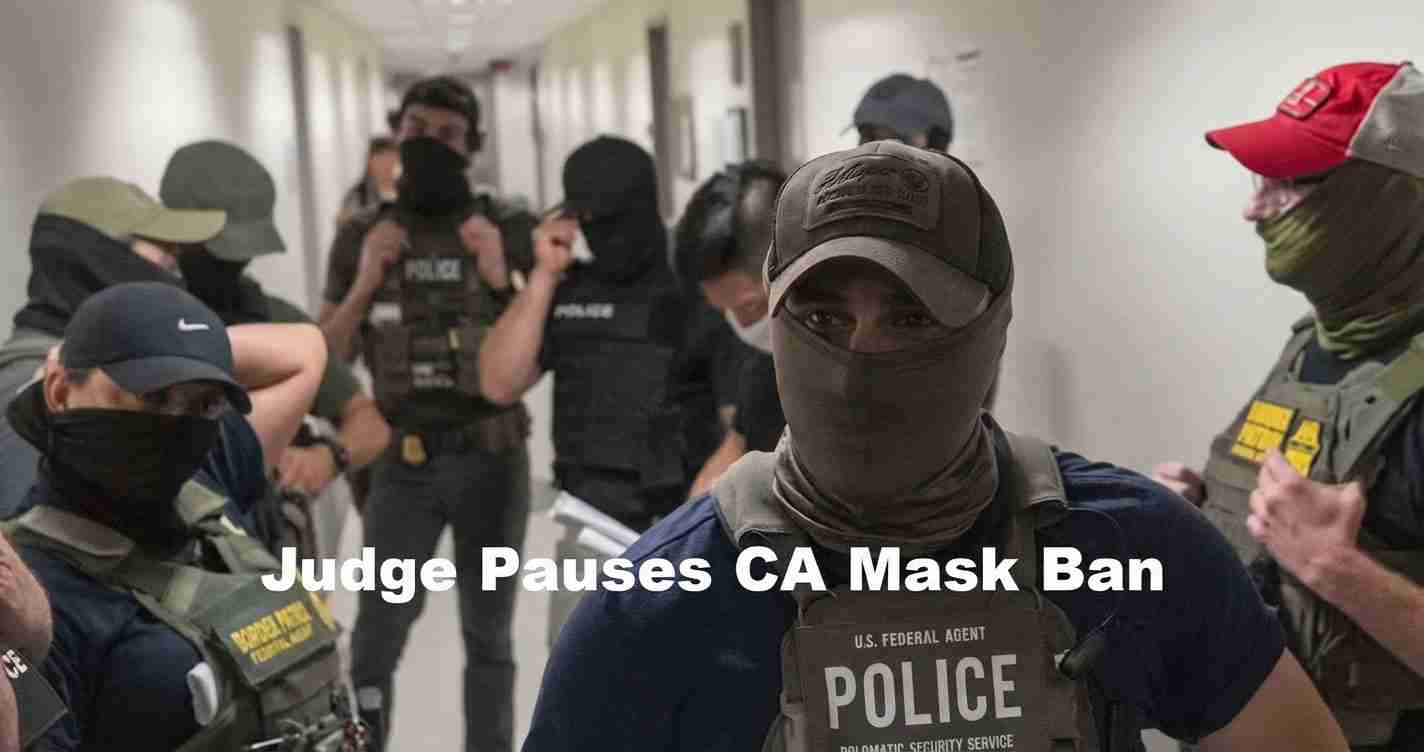
A federal judge in Los Angeles granted a preliminary injunction blocking California’s No Secret Police Act from being enforced against masked ICE agents, finding the statute unlawfully discriminates against federal officers and conflicts with the Constitution’s Supremacy Clause.
- 30-page preliminary injunction: U.S. District Judge Christina A. Snyder issued a 30-page decision granting a preliminary injunction that prevents California from enforcing the No Secret Police Act against federal immigration agents.
- Supremacy Clause ruling: Snyder found the mask ban unlawfully discriminates against the federal government by exempting state officers while penalizing federal officers, in violation of the Constitution’s Supremacy Clause (Politico report).
- Uniform identification law spared: The judge declined to enjoin a separate identification requirement in the No Vigilantes Act, finding it appears to apply uniformly to federal, state and local officers.
- Stay and appeals window: The order is stayed until Feb. 19 to allow parties time to seek further relief, including potential appeals to the 9th U.S. Circuit Court of Appeals (full story).
Ruling details and legal reasoning
Opinion focus: In a 30-page order, Judge Snyder centered her analysis on the Constitution’s Supremacy Clause, which establishes that federal law takes precedence over conflicting state or local laws. She concluded the No Secret Police Act treats federal officers differently by carving out an exemption for state law enforcement while penalizing federal agents who wear masks during immigration operations.
Snyder found that unequal treatment unlawfully discriminates against the federal government. The judge acknowledged California’s legitimate public interests—namely transparency and accountability—but wrote that those goals “do not justify a law that singles out federal officers.”
“These Acts serve the public interest by promoting transparency which is essential for accountability and public trust,” the opinion stated. “But the law is flawed because it does not apply equally to all officers.”
Snyder noted that a properly drafted, broader statute that covered state, local and federal officers alike might survive constitutional review; in short, a uniform law could meet transparency goals without running afoul of the Supremacy Clause (read the order).
Separate ruling on identification requirement
The federal government also asked the court to block California’s related identification measure—the No Vigilantes Act—which would require most officers to display a name or badge number while on duty. Snyder refused to enjoin that provision, finding it applies broadly and therefore does not present the same Supremacy Clause issue.
Although Snyder declined to block the identification rule, she stayed the overall effect of her ruling until Feb. 19, meaning the identification law will not be enforced before that date while the parties consider next steps (details).
Stay and possible appeals
Snyder temporarily stayed the injunction until Feb. 19 to allow both sides to seek further stays or emergency relief. The federal government may ask the 9th U.S. Circuit Court of Appeals for additional relief to extend the block on enforcement, which could lengthen the litigation timeline (source).
Reactions from officials
Attorney General Pamela Bondi praised the decision on X, saying federal agents “are being increasingly targeted for doing their jobs” and warning that the California law would have worsened safety risks for officers (report).
California Attorney General’s office: Led by Rob Bonta, the office had earlier agreed not to enforce either of the contested laws while the court considered the federal government’s request (coverage).
How the case reached this point
The Justice Department sued after California enacted statutes aimed at increasing transparency in law-enforcement contacts and limiting the use of masks during operations. DOJ argued the mask ban singled out federal officers and conflicted with federal authority over immigration enforcement. The court’s preliminary injunction halts enforcement of the mask rule while litigation continues (Politico).
Additional reporting on the decision and filings is available via Courthouse News Service.
What this means for federal-state relations
Legal scholars say the ruling highlights a central federalism tension: states can regulate policing practices, but they cannot single out or unduly burden federal functions. Snyder’s opinion underscores that transparency measures are permissible if drafted to apply uniformly to state, local and federal officers—providing California a pathway to pursue reforms consistent with the Constitution (analysis).
Implications for the Imperial Valley
Public safety and enforcement: The injunction allows federal immigration agents in the Imperial Valley to continue wearing masks during enforcement actions, limiting immediate visible changes for residents.
Community trust and transparency: Advocates who argued masked or unmarked agents erode trust will likely press state lawmakers to pursue a uniform identification rule that covers all officers; the judge’s decision suggests that approach may be legally viable.
Economic and labor impacts: The region—heavily dependent on seasonal immigrant labor—may see reduced immediate disruptions related to fears of masked federal operations, but ongoing legal uncertainty could keep employers and workers cautious.
Local law enforcement partnerships: County and city agencies that partner with federal authorities will continue operating under existing agreements while officials reassess whether to seek uniform rules about identification and masking in joint operations.
Practical effects for residents: For towns such as Calexico and El Centro, the immediate effect is continuity: current federal practices will remain in place while the injunction stands. If California rewrites its laws to apply evenly to all agencies, residents could see clearer standards on officer identification and face coverings.
Legal and legislative next steps
California officials can choose to revise the No Secret Police Act to apply uniformly, defend the statutes through appeals, or pursue alternative transparency measures. The federal government may seek additional stays from the 9th Circuit or press the constitutional claim through the courts—either path will shape whether the mask ban remains blocked and how identification rules are implemented statewide (report).