
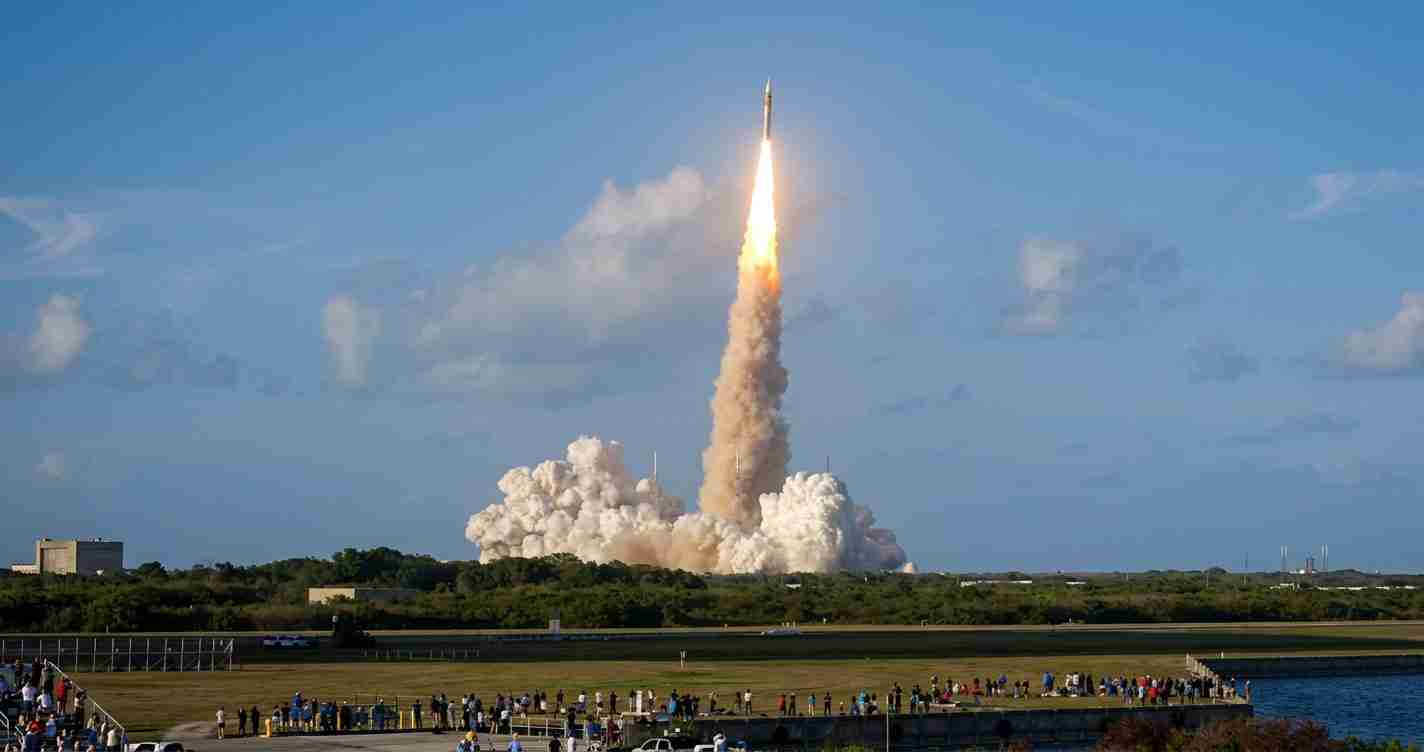
Artemis II lifts off: First crewed lunar flyby in more than 50 years sends four astronauts toward the Moon
NASA’s Artemis II launched April 1, 2026, from Kennedy Space Center, sending four astronauts on a 10‑day crewed lunar flyby — the first human journey to the Moon in more than 50 years, testing Orion and the Space Launch System.
Key takeaways
- Launch: Artemis II lifted off at 6:35 p.m. EDT from Launch Complex 39B on April 1, 2026; NASA live updates provided real‑time coverage.
- Crew: Commander Reid Wiseman, Pilot Victor Glover, Mission Specialist Christina Koch (NASA) and Mission Specialist Jeremy Hansen (Canadian Space Agency) are on the 10‑day free‑return lunar flight (Mission page).
- Trajectory and goals: A free‑return trajectory will take the crew around the Moon, with closest approach near day six (~8,000 km), validating Orion and SLS systems for future Artemis landing missions.
- Public engagement: The public can follow the mission via the Artemis mission site, Artemis Real‑time Orbit Website and the NASA mobile app.
Launch and early flight: what happened and why it matters
Artemis II reached supersonic speed and cleared the tower within minutes of liftoff. The Space Launch System (SLS) core stage and four RS‑25 engines burned for roughly eight minutes. At about 8 minutes and 14 seconds after liftoff, the core stage separated from the interim cryogenic propulsion stage, and Orion continued into a high Earth orbit.
Shortly after separation, Orion deployed its solar array wings and the crew began system checks. Orion will spend about one day in high Earth orbit verifying communications, life support and navigation systems; if nominal, the crew will depart toward the Moon on mission day two. NASA describes this flight as a critical test before crewed lunar landings on later Artemis missions (NASA mission overview).
“A beautiful moonrise,” Commander Reid Wiseman said moments after launch, capturing the emotion of returning humans to deep space.
Crew milestones and team dynamics
The four‑member crew wore the bright orange flight suits familiar from NASA launches. Reid Wiseman commanded the mission; Victor Glover serves as pilot; Christina Koch and Jeremy Hansen are mission specialists. Notable milestones include Victor Glover as the first person of color and Christina Koch as the first woman to travel beyond low Earth orbit on this mission, while Jeremy Hansen represents the Canadian Space Agency.
Planetary scientists and observers called the launch inspiring and emblematic of teamwork. UC Berkeley planetary scientist Lindy Elkins‑Tanton described the crew as “a spectacular team”, noting that diverse backgrounds strengthen mission capability and public resonance (Kennedy Space Center event page).
Technical context and mission goals
Artemis II is the first crewed flight of the SLS rocket and a major test of Orion’s deep‑space systems. It builds on Artemis I, the uncrewed test of Orion around the Moon in 2022. Data and experience from Artemis II will inform upcoming Artemis missions (IV and V) that aim to return humans to the lunar surface and establish a sustained presence by 2028 and beyond (Mission background).
Before launch the program addressed hydrogen fuel leaks and a helium flow issue to the rocket’s upper stage, which delayed rollout and launch. The full stack was rolled to the pad on January 17, 2026, after the core stage had arrived months earlier. Flight teams implemented final built‑in holds and a T‑10 minute hold during the April 1 window to reduce risk for the crewed flight.
Flight path and the possibility of a lunar eclipse
Artemis II follows a free‑return trajectory, looping around the Moon and using lunar gravity to return the spacecraft without entering lunar orbit. Closest approach is expected near mission day six at roughly 8,000 kilometers above the surface, and the mission may carry humans farther from Earth than ever before — potentially exceeding 400,000 kilometers.
NASA officials noted the crew may witness a solar eclipse from Orion when the spacecraft passes behind the Moon and the Moon blocks the Sun from their perspective (Mission overview; NASA blog).
Public engagement and tracking the mission
Members of the public can follow mission milestones through NASA’s coverage, the Artemis Real‑time Orbit Website and the NASA mobile app. Live video and social channels provided launch commentary from scientists and engineers; observers described the moment as historic and emotionally powerful. Planetary scientist Paul Byrne, watching from about 17 kilometers away, said he was still “shaking” from the adrenaline.
For live coverage and tracking, see the Artemis mission site and related live updates (NASA live updates); video and commentary are also available via public streaming (launch commentary video).
Source notes and reporting
This article draws on NASA’s launch‑day coverage and mission pages, Kennedy Space Center event materials and the Artemis II mission overview. Key sources include NASA live updates, the Artemis II mission page, the Kennedy Space Center event overview, and background reference material (Wikipedia: Artemis II).
Implications for The Imperial Valley, California
Economic impact: Although the launch occurred in Florida, federal investment in space and aerospace manufacturing can flow nationwide. Imperial Valley businesses, universities and technical colleges could benefit via supplier contracts, research partnerships, internships and workforce training tied to NASA programs. This may create grant opportunities and new curriculum development at institutions such as Imperial Valley College.
Political consequences: Space missions influence federal spending priorities and local debates about education and workforce development. Local leaders in Imperial County could leverage Artemis II’s success to advocate for increased STEM funding, vocational training and federal partnerships that connect residents to aerospace pipelines.
Social effects: Artemis II can inspire students and families across the region. Schools and community organizations can host watch parties, student projects and public events using free NASA materials to promote STEM pathways and workforce retention.
Cultural relevance: The mission’s teamwork narrative — diverse crew members working toward a shared goal — resonates with the Imperial Valley’s community values and cultural diversity. Milestones on the flight may be especially meaningful locally.
Practical applications for residents: Residents can follow the mission in real time using NASA tools (Artemis mission site). Schools, libraries and community centers can host viewings and educational programs using NASA resources and online mentorships.
How local leaders and educators can act now
- Coordinate watch events: Schools and colleges should organize public viewings and integrate NASA curricula into classroom lessons (NASA education resources).
- Workforce development: Agencies can partner with regional aerospace employers and community colleges to create short‑term certificates for technician roles supporting the space industry.
- Economic development: Identify grant programs and federal partnerships that align local capacity with NASA contracts and research funding.
Reporting for this article is based on NASA and Kennedy Space Center materials; see linked sources above for full launch‑day coverage, mission pages and additional context.


