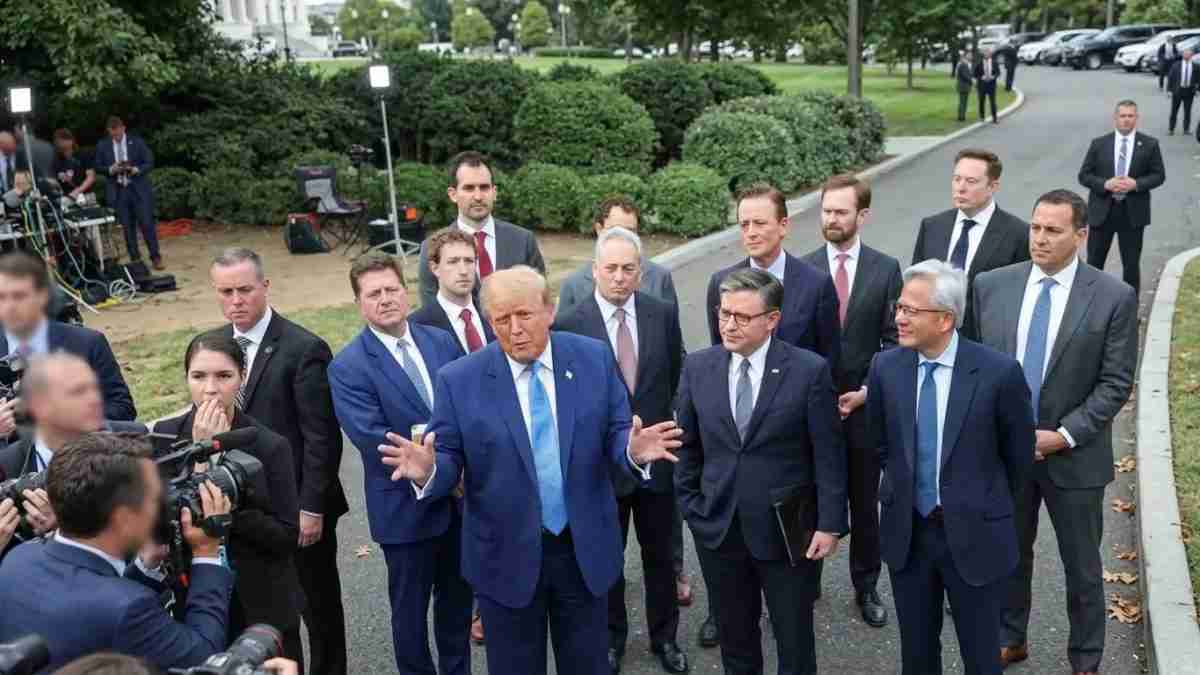
WASHINGTON, Oct. 4 (Infinite Headlines) — An executive order signed by President Donald J. Trump directs federal executive agencies to call artificial intelligence “Super Intelligence,” or “SI,” in their official communications. The immediate change is to government language, not to the capabilities of the technology covered by the order.
Executive Order 14434, “Inaugurating the Era of Super Intelligence,” signed September 29, 2026, keeps the existing federal statutory definition of artificial intelligence while setting up a process to consider a different definition. Understanding that distinction helps separate the administration’s policy from the much broader technical idea of superintelligence.
What changes under the order?
The order directs executive departments and agencies to replace “Artificial Intelligence” and “AI” with “Super Intelligence” and “SI,” to the maximum extent permitted by law.
The direction covers official correspondence, public communications, websites, reports, policy documents and other non-statutory executive-branch documents. It does not require changes to previously issued regulations, presidential actions, contracts, grants or other historical documents.
The administration says the new language reflects the technology’s advancing capabilities and promise. The order’s descriptions of frontier-system capabilities are administration claims, rather than independent verification that systems meeting the technical concept of superintelligence exist.
Does “SI” now mean something different from “AI” in federal policy?
For purposes of the order, generally no. Except where the law provides otherwise, “Super Intelligence” and “SI” encompass the same technologies and systems covered by the definition of artificial intelligence in 15 U.S.C. § 9401(3), a provision of federal law.
The order incorporates that definition rather than replacing it with a new technical threshold. That arrangement remains in place unless superseded by a later lawful presidential action or an act of Congress.
In this policy, “SI” therefore serves as a new label for an existing legal category. It does not require a system to demonstrate greater-than-human intelligence before falling within the order’s terminology.
What does superintelligence mean as a technical concept?
Philosopher Nick Bostrom describes superintelligence in his book Superintelligence as an intellect that greatly exceeds human cognitive performance in virtually all domains of interest.
That is a substantially more demanding concept than the order’s use of the term. It concerns the breadth and level of an intelligence’s abilities, rather than whether a system belongs to the existing statutory AI category.
A related idea is an “intelligence explosion.” The Machine Intelligence Research Institute describes this as a possible scenario in which a machine becomes better than humans at designing AI, then improves its own intelligence through a feedback loop. Improved intelligence would support further improvements.
The institute presents that scenario as a possibility, not as an observed consequence of the executive order.
Could the legal definition change later?
The order requires the Assistant to the President for Science and Technology to submit proposed legislative language to the president within 60 days of September 29, 2026. The assistant is to consult agency heads as the assistant considers appropriate.
The proposal must assess whether a new federal definition should modify, expand or supersede the existing statutory AI definition. It must also address possible related changes to other statutes and recommend any further presidential or executive action.
This is a direction to prepare proposals for the president, not an adoption of a future definition or a requirement to submit legislation directly to Congress.
What limits apply to implementation?
Implementation is subject to applicable law and available appropriations—the funding available for government spending. The order says it creates no enforceable right or benefit.
It also preserves existing agency authorities and the specified functions of the director of the Office of Management and Budget. The Office of Science and Technology Policy is responsible for the order’s publication costs.