8th Circuit says SAVE plan ended, forcing millions to seek new student loan repayment options
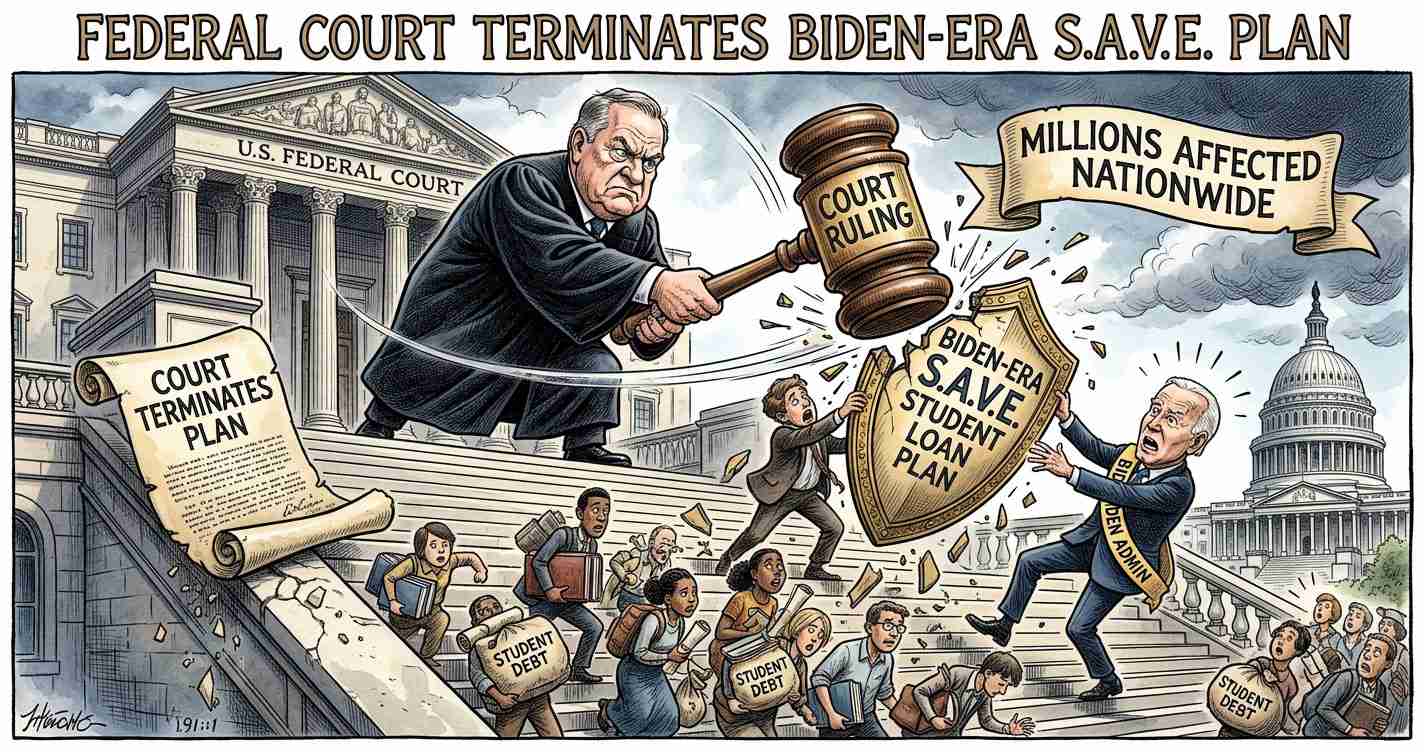
The 8th U.S. Court of Appeals on March 9, 2026, ended the SAVE student loan repayment plan, forcing millions of federal borrowers to switch to alternatives such as Income-Based Repayment and the upcoming Repayment Assistance Plan.
- Court action finalized: The 8th U.S. Court of Appeals reversed a lower-court dismissal on March 9, 2026, ending the SAVE plan for new and existing enrollees; see The College Investor coverage.
- Millions affected: More than 7 million borrowers were enrolled in SAVE in late 2025; the Department of Education negotiated a settlement to halt new enrollments and move current enrollees to other programs, per the Department of Education announcement and Student Loan Planner timeline.
- Alternatives and timing: Borrowers should evaluate Income-Based Repayment (IBR) now and the Repayment Assistance Plan (RAP), which begins July 1, 2026; see the TCNJ financial aid update.
Background: what SAVE did and why it mattered
Introduced in 2023 under President Joe Biden, the Saving on a Valuable Education (SAVE) plan was promoted as the most affordable federal repayment option ever because it covered 100% of unpaid monthly interest for qualifying borrowers, preventing balances from growing and helping many reach forgiveness sooner.
Borrower advocates argued SAVE provided tangible relief. However, the plan became the subject of litigation brought by Missouri and other Republican-led states, creating legal uncertainty and confusion for borrowers trying to secure credit toward forgiveness. For timeline and analysis, see Student Loan Planner.
Court developments: how the ruling unfolded
In February 2026, U.S. District Judge John Ross in the Eastern District of Missouri dismissed the legal challenge to SAVE, a decision some borrower groups hailed as a win and urged the Department of Education to resume SAVE processing. That dismissal was subsequently reversed.
March 9, 2026: The 8th U.S. Court of Appeals reversed the district court’s dismissal and finalized the end of SAVE, enforcing settlement terms that remove SAVE protections and require the Department to transition borrowers to alternative repayment programs; read more via The College Investor and the Department announcement.
The Education Department described the settlement as necessary to resolve legal issues, characterizing SAVE in its December 2025 statement as an “illegal bailout.” The department said it will conduct outreach to help borrowers transition; see the full press release.
Legislative context: OBBBA and the phase-out of older plans
The One Big Beautiful Bill Act (OBBBA) — also known as the OB3 Act — passed last year and set a schedule to sunset certain repayment plans, including SAVE, Income-Contingent Repayment (ICR), and Pay As You Earn (PAYE) by July 2028. The court ruling accelerates the end of SAVE now, while OBBBA governs longer-term repayment program changes; see analysis at Student Loan Planner and the TCNJ update.
What repayment options look like now
With SAVE ended, borrowers should review alternatives and act promptly. Key options include:
- Income-Based Repayment (IBR): Payments generally set at 10%–15% of discretionary income, with forgiveness after 20–25 years depending on loan type and disbursement date; see Student Loan Planner and the TCNJ update.
- Repayment Assistance Plan (RAP): Effective July 1, 2026, RAP sets payments on a sliding scale tied to Adjusted Gross Income (AGI), with payments ranging from 1%–10% of AGI and a 30-year repayment requirement for participants; see Student Loan Planner and the TCNJ update.
- Standard, Graduated and Extended plans: Fixed-payment plans remain available; standard pays off loans fastest but with higher monthly bills, while graduated and extended lower initial payments at the cost of more interest over time (TCNJ).
- Public Service Loan Forgiveness (PSLF): Eligible borrowers should verify and file employer certification and PSLF applications now to ensure months count; some who had SAVE progress frozen may reclaim credit if they meet PSLF rules — see Student Loan Planner.
Actions for borrowers: steps to protect progress and avoid surprises
The Department and servicers will conduct outreach, but borrowers should not wait. Suggested immediate steps:
- Check accounts regularly: Review your loan status and servicer portal. Use the Department of Education Loan Simulator and official guidance to model payments and compare options.
- File PSLF paperwork: If pursuing PSLF, submit employer certification forms and the PSLF application to document qualifying work and payments — do not assume time in SAVE will count automatically (Student Loan Planner).
- Prepare for possible higher payments: Servicers may auto-enroll borrowers into other plans if no action is taken; auto-enrollment policies are scheduled through July 1, 2028 (TCNJ update).
- Watch for forbearance changes: Limits have been tightened, with forbearance capped at nine months in any two-year period (TCNJ).
- Be mindful of tax issues: Federal tax treatment of forgiven debt changed after 2025; forgiveness may be taxable unless Congress acts (TCNJ).
Implications for The Imperial Valley, California
Economic impact: The Imperial Valley — home to many working families, students, and recent graduates — could see reduced household spending if borrowers face higher monthly payments under IBR or other plans, affecting small businesses, retail, and service sectors across Imperial County.
Political consequences: Local officials and community leaders should expect more constituent questions about student debt relief and may be pressed to seek clearer federal guidance and additional supports for workforce development and graduates.
Social effects: First-generation college students and lower-income families could face increased strain on housing, transportation, and healthcare choices; community colleges and nonprofits may see higher demand for counseling and emergency aid.
Cultural relevance: For many Imperial Valley residents, education remains a pathway to upward mobility. The end of SAVE may feel like a rollback of progress toward affordable higher education and long-term debt relief.
Practical local steps:
- Contact your servicer and check federal loan accounts online; use the Department Loan Simulator.
- Visit Imperial Valley College’s financial aid office or the San Diego State University Imperial Valley campus for counseling; county workforce centers and local nonprofits may offer help.
- If you work in public service, file PSLF paperwork and obtain employer certification now to protect months of qualifying service (Student Loan Planner).
- Watch for Department outreach and servicer notices; do not ignore messages about plan changes or auto-enrollment.
Legal and local advocacy
Local legal aid organizations and borrower advocacy groups may host clinics and workshops to explain the 8th Circuit decision and next steps. Borrowers who believe they were harmed by plan changes should document communications with servicers and consider contacting consumer protection agencies or legal aid for assistance.
Sources and resources
This article draws on court coverage, Department notices, and expert analysis. Key resources:
- Department of Education Loan Simulator and official guidance
- Student Loan Planner timeline and analysis
- Coverage of the 8th Circuit decision (The College Investor)
- Update on federal loan rule changes (TCNJ financial aid)
Need help? Readers in the Imperial Valley should contact their loan servicer, local college financial aid offices, or county support services as soon as possible to understand how the end of SAVE affects loans and household budgets.